
Anti-Shopping Trap Guide
Drawn from 48 typical cases released by China’s Ministry of Culture and Tourism between 2024 and 2025, this guide helps you spot pitfalls, protect your rights and interests, and enjoy a pure journey through China.
Updated June 11, 2026
Anti-Shopping Trap Guide for Foreign Visitors to China
Dear International Travelers:
Welcome to China!
China is a country with over 5,000 years of history and civilization, making it an outstanding destination for travelers and explorers. However, during your travels, some unscrupulous agencies and guides take advantage of information gaps, using “low-price shopping tours” to violate tourists’ rights.
Drawn from 48 typical cases released by China’s Ministry of Culture and Tourism between 2024 and 2025, this guide helps you spot pitfalls, protect your rights and interests, and enjoy a pure journey through China.
1. Identification of common shopping traps
These signals means you may be stuck in a shopping Group
The price is unusually low
The full package price for 6 days and 5 nights is less than 1000 yuan (about US $140), and even “Zero tour fee” and “negative tour fee” will inevitably make up for the loss through compulsory shopping.
The word “government subsidy”
Claims that “the government requires shopping to subsidize tourism”, “government cooperation in poverty alleviation projects”, “special drugs for troops”-are all fictitious, and the Chinese government has never asked tourists to shop.
Masquerading as a “cultural experience”
Visit the “Jade Museum”, “Tea Base”, “Latex Factory”, “Tibetan Medicine Research Institute” and so on, in fact, shopping shop packaging. A stay of more than 90 minutes is the point of purchase.
Contract intentionally ambiguous
The itinerary only writes “characteristic experience” and “folk custom visit”, and does not indicate the specific store name, shopping times and stay time.
Restriction of personal freedom
Tourists stranded in the parking lot or shop, do not buy not to leave; Tour guides monitor visitors to the bathroom.
Threatening and humiliation
“One item in each hand”, “Don’t give me all kinds of reasons”, “Lao Tzu has brought a regiment for 10 years, and there has never been a fish in his hand”-typical forced consumption of speech skills.
Emotional kidnapping
“Tour guides have a meager basic salary and rely on you to support their families” and “support local economic development”-induced guilt trip.
Onboard Sales Pitches
Tour guides peddle local products, health care products and trinkets on the way, using the enclosed space to exert pressure.
Common Types of Shopping Stores in Popular Tourist Cities
• Yunnan (Kunming / Dali / Lijiang) – Jade and emerald shops, silver stores, latex mattress places, Chinese medicine shops, Huanglong jade stores. Those jade bracelets? The price tag is often dozens of times higher than the real value.
• Guilin – “Blood jade” museums, local specialty shops, latex product stores. Most of that “blood jade” is just regular rock that’s been dyed.
• Zhangjiajie – Cinnabar shops, Meicha (vine tea) stores, local gift shops. They’ll tell you cinnabar scares away evil spirits and vine tea cures everything. Yeah, right.
• Beijing – Jade malls, cloisonné factories, roast duck places, Tongrentang. You see a jade piece priced at tens of thousands of yuan? It’s probably worth a few hundred.
• Xi’an – Lantian jade shops, Terracotta Warrior souvenir stores, snack shops in the Muslim Quarter. Most of that “Lantian jade” is actually just jade from Henan sold under a fake name.
• Chengdu / Chongqing – Tea shops (Pu’er), Sichuan seasoning stores, jade and silverware shops. That “Tibetan silver” or “Miao silver”? It’s mostly just alloy.
• Xiamen – Tea shops (Tieguanyin), pearl stores, dried seafood places. Most of those pearls are cultured, but they sell them as natural.
• Guangzhou – Jade wholesale markets, leather goods malls, tea markets. It’s a mixed bag of good and bad. If you’re not a pro, better be careful.
Industry Insider Secrets(Where Does Your Money Go? )
According to China’s Ministry of Culture and Tourism and industry surveys, here’s how the shopping tour scam works:
• Travel agencies: They take tourists for below cost – sometimes even zero-fare trips – gambling that shopping commissions will cover it. On top of that, they charge shops a “head fee” of 50–200 yuan per person per store, plus 30–80% of sales.
• Tour guides: Barely any base salary, or none at all. They survive purely on kickbacks from shopping – usually 20–40% of what tourists spend.
• Drivers: They get 10–30 yuan per passenger per store as a parking subsidy, or a 5–10% cut of sales.
• Gift shops: The products cost just tens of yuan to make, but the price tag says tens of thousands. Gross margins can hit over 90%.
Representative Cases: A certain travel agency in Yunnan charged 800 yuan per person for a 6-day tour, however, the real cost was 1,200 yuan. The 400 yuan loss per person had to be covered by shopping kickbacks.
2. How to protect yourself when forced to shop?

Clearly refuse.
State on the spot, “I don’t need to buy anything.” Demand that the tour guide provide a written certificate proving forced shopping. According to Article 35 of the Tourism Law of the People’s Republic of China, unless mutually agreed, travel agencies may not designate specific shopping venues.
Collect evidence immediately.
Turn on your phone’s audio or video recording. Capture any threatening language from the guide, situations where you are made to stay, and the shopping venue environment. Evidence is the core of any subsequent rights protection.
Call helplines.
• National unified tourist complaint hotline: 12345
• Police: 110
• Complaint platform of the Ministry of Culture and Tourism: www.12301.cn
• On site, you can demand that the guide provide the travel agency’s business license and the guide’s license number.
Never leave the group on your own.
Even if you are kicked off the bus or verbally abused, do not leave the group without authorisation. “Leaving the group without authorisation” could be used by the travel agency against you as a reason to refuse any refund. Stay where you are and call the police.
Keep all purchase receipts.
Contracts, itineraries, payment receipts, shopping invoices, audio and video recordings, the guide’s business card — save everything for at least six months.
Be careful with payments.
Do not use cash for large shopping payments under pressure from the guide. Paying by card or scanning a QR code leaves a transaction record, which makes it easier to trace later.
Unite with other tourists.
Most people in a forced-shopping tour are victims. A group refusal to buy and a group complaint are far more effective than fighting alone.
Contact your hotel / embassy.
If you are abandoned in an unfamiliar place, contact the hotel you are staying at to help you call the police. If necessary, get in touch with your country’s embassy or consulate in China.
3. How to choose formal tourism products?
Booking channel priority
• First priority: China’s well-known established travel agency bespoke china — The platform has a complaint mechanism. For all our clients, we arrange no-shopping, high-end customised products. We do not enter any shopping stores, and we promise absolutely no store visits.
• Be cautious: “Local experts” or “student guides” recommended on social media / forum overseas versions of Xiaohongshu, TIKYOK, Facebook groups — They may be unlicensed illegal guides.
• Avoid: Low-price flyers. For example, if the China travel product you book, excluding major transportation, costs less than 150 USD per person per day, then be cautious. It is clearly below the industry’s normal cost — 99% of the time it is a shopping tour trap.
Seven elements that must be clearly stated in the contract
- Specific names of scenic spots (without writing “etc.” or “related spots”)
- “No shopping” must be clearly marked
- List and prices of optional activities at your own expense
- Names or star ratings of accommodation hotels
- Meal standards (how many meals, how many meat dishes and how many vegetable dishes)
- Type of transportation (air-conditioned tour bus / coach / high-speed train)
- Tour guide qualifications (whether they hold a guide certificate issued by the National Tourism Administration)
4. What to Do If Your Rights Have Been Violated?
• Step 1: Negotiate with Travel Agents
Retention of evidence and written claim for refund/compensation. According to Article 35 of the “Tourism Law”, travel agencies arrange shopping in violation of regulations, and tourists have the right to request a return and advance payment for the return within 30 days after the end of the trip, or request a refund of the cost of separately paid items.
In this above we provide tourists travel in China 24 hours a day service, provide emergency treatment in any case.
• Step 2: Platform Complaints
Complaints are submitted through our platform, which usually has an advance payment mechanism.
• Step 3: Administrative Complaints
Call the 12345 hotline or login www.12301.cn national tourism complaints platform. The Ministry of Culture and Tourism has implemented “zero tolerance” for forced shopping, and dozens of travel agency licenses have been revoked from 2024 to 2025.
• Step 4: Legal Proceedings
If personal injury or significant property damage is caused, a civil lawsuit may be filed in a Chinese court. Under the Consumer Protection Act, triple damages (fraud) can be claimed.
• Step 5: Media Exposure
Report to Chinese Media (e.g. CCTV “Focus Interview” “Weekly Quality Report”) or international media. After the incident of “driving tourists out of the car” in Yunnan in 2025 was reported by CCTV, the tour guide involved was revoked his license.
-1024x661.jpg)
5. The Chinese Government’s Resolve to Rectify (Official Enforcement Cases)
From 2024 to 2025, China’s Ministry of Culture and Tourism, in collaboration with public security and market regulation authorities, carried out a whole-chain rectification. Three batches of circulars disclosed a total of 48 typical cases:
• May 2025: The first batch of 16 typical cases was released; multiple travel agencies had their operating permits revoked.
• July 2025: Unlicensed tour guide Song was detained for 10 days by the Dali Municipal Public Security Bureau for forced shopping.
• September 2025: The third batch of circulars exposed travel agencies using a “betting” model — taking customers at a loss and counting on shopping revenue to recover costs.
Typical case links (available on the official website of China’s Ministry of Culture and Tourism):
• The case of Yunnan tour guide Tian, who coerced tourists into shopping and ejected them from the bus.
• The case of a certain Guilin travel agency for false advertising (fined 214,000 yuan).
• The case of Beijing tour guide Zhao, who unilaterally discontinued services.
• The case of Zhangjiajie tour guide Zhu, who fabricated “government cooperation”.
These cases demonstrate: The Chinese government is rigorously cracking down on tourism shopping misconduct, and tourists’ rights protection has a firm legal basis.
6. Quick Facts
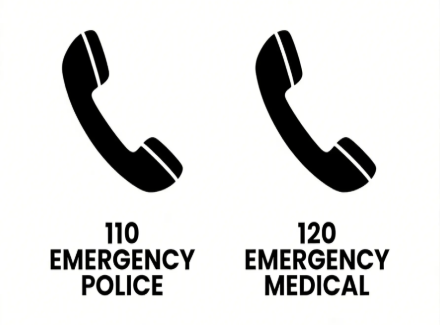

Emergency numbers:
• Police: 110
• Tourist complaint: 12345
• Medical emergency: 120, Fire: 119
Official platforms:
• Ministry of Culture and Tourism: www.mct.gov.cn
• Tourist complaint platform: www.12301.cn
• Consumer rights protection: www.cca.org.cn
Embassies of major countries in China:
• USA: +86-10-8531-3000
• UK: +86-10-5192-4000
• Australia: +86-10-5140-4111
• Canada: +86-10-5139-4000
(It is advisable to save your own country’s embassy contact details before travelling)